
How-to
Theme night meal planning: fewer decisions, same variety

Short answer
Theme night meal planning means assigning a category, such as Taco Night or Pasta Night, to each day of the week instead of a specific dinner. You then only choose which taco or which pasta, not which of hundreds of possible dinners. The theme repeats every week; the meal inside it changes.
“What should we have for dinner?” is a much harder question than “what kind of taco do we want tonight?” Theme nights work by asking the second question instead of the first. You are not planning fewer dinners. You are just choosing from a shelf instead of staring at an empty page.
What is theme night meal planning?
It is assigning a category to each night of the week, instead of a specific recipe. Monday might always be Taco Night, Tuesday always Pasta Night. The theme stays fixed; the actual dish rotates, so you are not eating the same thing every week, only the same kind of thing on the same night.
This is a well-worn trick among meal planners, not a new idea: multiple people we asked in a Reddit thread on r/mealprep landed on it independently, and sites like Good Cheap Eats and Family Food on the Table have been publishing theme-night templates for years. It works because narrowing the category does most of the deciding for you before you even open the fridge.
How do I pick themes that actually work for my week?
Pick themes around what your week already looks like, not the other way around. A few starting points:
- Your busiest night gets your fastest theme. If Wednesday is chaos, Wednesday is Sheet-Pan Night or Taco Night, not the night you attempt something with four pans.
- One night is always a fallback. Leftovers, breakfast-for-dinner, or “whatever’s in the freezer” keeps one night from ever becoming a crisis.
- Themes can be broad or narrow. “Pasta Night” is broad. “Slow Cooker Night” is a method, not a cuisine, and works well for a day you’re out of the house until 6.
- Keep it to five or six. More than that and you are back to inventing a full week from scratch.
- Picky eaters at the table? Pick themes that come apart, like tacos or bowls, so everyone builds their own plate. Here are more dinner ideas for picky kids.
Four theme nights, with a real dinner for each
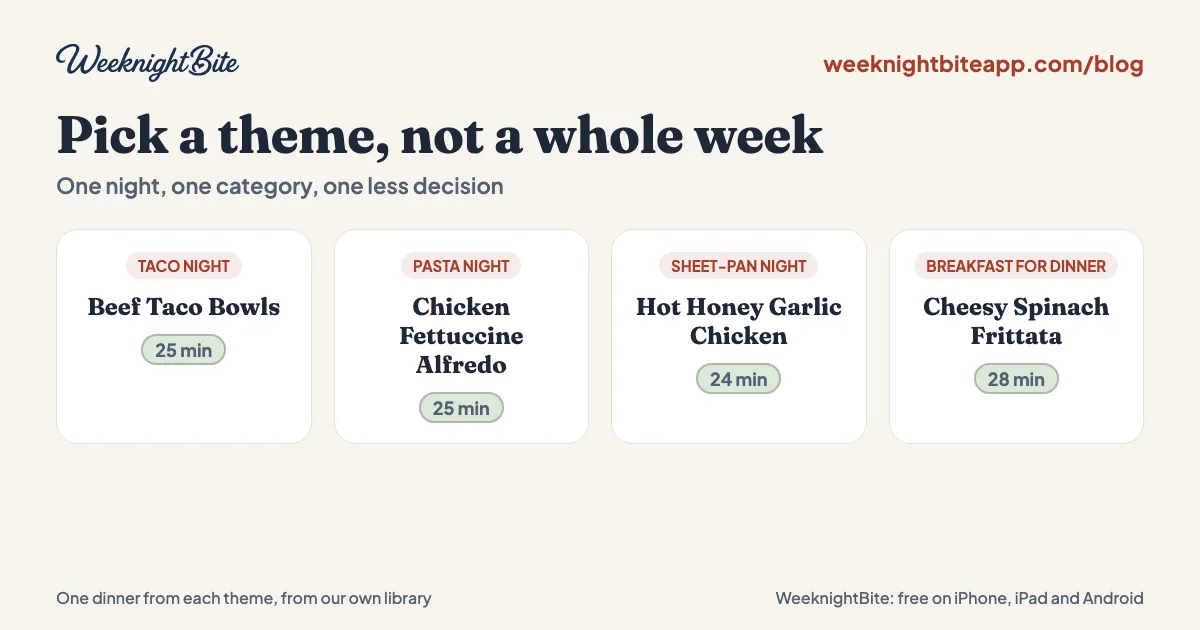
Here is a starter set, each with an actual dinner from WeeknightBite’s library so you can see what “choosing within the theme” looks like in practice. Every recipe below is cooked and tested by a person before it goes in the app.
| Theme | A dinner that fits | Time |
|---|---|---|
| Taco Night | Mild Beef Taco Bowls with Rice & Sweet Corn | 25 min |
| Pasta Night | Pan-Seared Chicken Fettuccine Alfredo | 25 min |
| Sheet-Pan Night | Hot Honey Garlic Chicken with Apple Slaw & Sesame | 24 min |
| Breakfast-for-Dinner Night | Cheesy Spinach Egg Frittata with Toast & Roasted Tomatoes | 28 min |
A fifth theme worth having, even though we don’t have a dinner to point you to yet: Slow Cooker Night, for the one day you’re out of the house all afternoon. WeeknightBite’s library doesn’t include a slow-cooker recipe today, so pick your own go-to for that one and let the app handle the other nights.
28 theme night ideas, grouped four ways
Most themes are one of four kinds: a type of food, a way of cooking, a cuisine, or a rule for the night. Mix the kinds, so the week isn’t five cuisines in a row. Where WeeknightBite’s library has a dinner that fits, it is linked.
By type of food
- Taco Night: Green Chile Turkey Enchilada Skillet with Lime Crema, tortillas and all in one pan
- Pasta Night: Classic Beef Bolognese with Rigatoni & Grated Parmesan
- Soup Night: Tuscan Kale & White Bean Soup with Parmesan Garlic Toast
- Bowl Night: Caribbean Black Bean & Mango Bowls with Coconut-Lime Rice
- Burger Night: Crispy Black Bean Burgers with Avocado Spread & Mixed Greens Salad
- Big Salad Night: Chicken BLT Cobb Salad with Jammy Eggs, Croutons & Ranch
- Wrap or Sandwich Night: Balsamic Chicken Wraps with Goat Cheese, Cranberries & Lemony Arugula
- Breakfast-for-Dinner Night: Apple, Bacon & Cheddar Frittata with Arugula Salad & Sourdough
- Pizza Night: homemade, frozen or ordered; it still counts as planned
- Baked Potato Night: one tray of potatoes, toppings on the table
By way of cooking
- Sheet-Pan Night: Sheet Pan Greek Shrimp with Blistered Tomatoes, Feta & Lemon Couscous
- One-Pot Night: One-Pot Beef & Pumpkin Chili with Cool Greek Yogurt, and there are more in our one-pot dinner recipes
- Skillet Night: Cheesy Broccoli Chicken Skillet with Jasmine Rice & Cheddar
- Air Fryer Night: Air Fryer Chicken Cordon Bleu with Lemon-Dijon Sauce & Asparagus
- Stir-Fry Night: Kung Pao Tofu with Bell Peppers, Celery, Cashews & Jasmine Rice
- Slow Cooker Night: for the day you’re out until 6
- Grill Night: for the months it’s light after dinner
By cuisine
- Mexican Night: Cilantro-Lime Chicken Thighs with Avocado-Tomato Salsa & Mexican Rice
- Italian Night: Garlic Butter Shrimp Scampi with Linguine & Blistered Cherry Tomatoes
- Indian Night: Mild Butter Chicken with Basmati Rice & Sweet Peas
- Korean Night: Korean Gochujang Beef with Jasmine Rice & Pickled Cucumbers
- Greek Night: Crispy Greek Lemon-Oregano Chicken Thighs with Roasted Potato Wedges & Tzatziki
By a rule for the night
- Meatless Monday: Golden Coconut Red Lentil Dal with Spinach & Basmati
- Fish Friday: Pesto-Crusted Salmon with Lemon Orzo & Blistered Tomatoes
- Leftovers Night: whatever is in the fridge, reheated without apology
- Kids’ Choice Night: one child picks from two or three options you can live with
- New Recipe Night: the one night you try something you haven’t made before
- Freezer Night: something you cooked double of last month
What does a week of theme nights look like?
Five themes and two loose nights is plenty. Two examples:
| A busy school week | A week with more time | |
|---|---|---|
| Monday | Meatless Monday | Soup Night |
| Tuesday | Taco Night | Mexican Night |
| Wednesday | Sheet-Pan Night | Stir-Fry Night |
| Thursday | Pasta Night | New Recipe Night |
| Friday | Pizza Night | Fish Friday |
| Saturday | Leftovers Night | Grill Night |
| Sunday | Kids’ Choice Night | Slow Cooker Night |
How do I actually plan the week once themes are set?
Once the themes exist, planning a week is just five small decisions instead of one big one:
- Look at your week. Which night is genuinely the hardest?
- Slot your fastest or simplest theme there.
- For every other night, pick one dinner that fits that night’s theme.
- Save the plan. The grocery list is built from whatever you picked, combined into one list.
- Repeat next week with different choices inside the same themes.
If you’d rather not choose the dinner yourself even within a theme, WeeknightBite’s Suggested Weeks feature shows you whole-week plans to swipe through instead of building one from scratch.
What if a theme doesn’t fit one week?
Skip it. A theme is a default, not a rule. If Taco Night doesn’t sound good this week, that night becomes leftovers or a fallback, and Taco Night comes back next week. The point of a theme is to remove a decision most weeks, not to lock you into it every week.
Frequently asked questions
How many theme nights should I have?
Five or six is enough to cover a normal week without feeling repetitive. Fewer than that and you’ll run out of variety; more than that and you’re back to planning from scratch.
Does Taco Night mean the same tacos every week?
No. The theme is the category, not the dish. One week it might be beef taco bowls, another week a different filling entirely. Only the night’s slot stays the same.
Can theme nights work for a family with different tastes?
Yes, because the theme sets the category and everyone can still pick or build their own version within it, the same way a taco bar lets each person fill their own.
Is WeeknightBite available yet?
Yes. WeeknightBite is free to download on iPhone, iPad and Android; the button at the end of this post takes you to the App Store or Google Play. Coming from Mealime? Paste your recipe links on our Mealime page, and they will be waiting in your account.