
Problem post
ADHD meal planning: cut the deciding, keep the dinner

Short answer
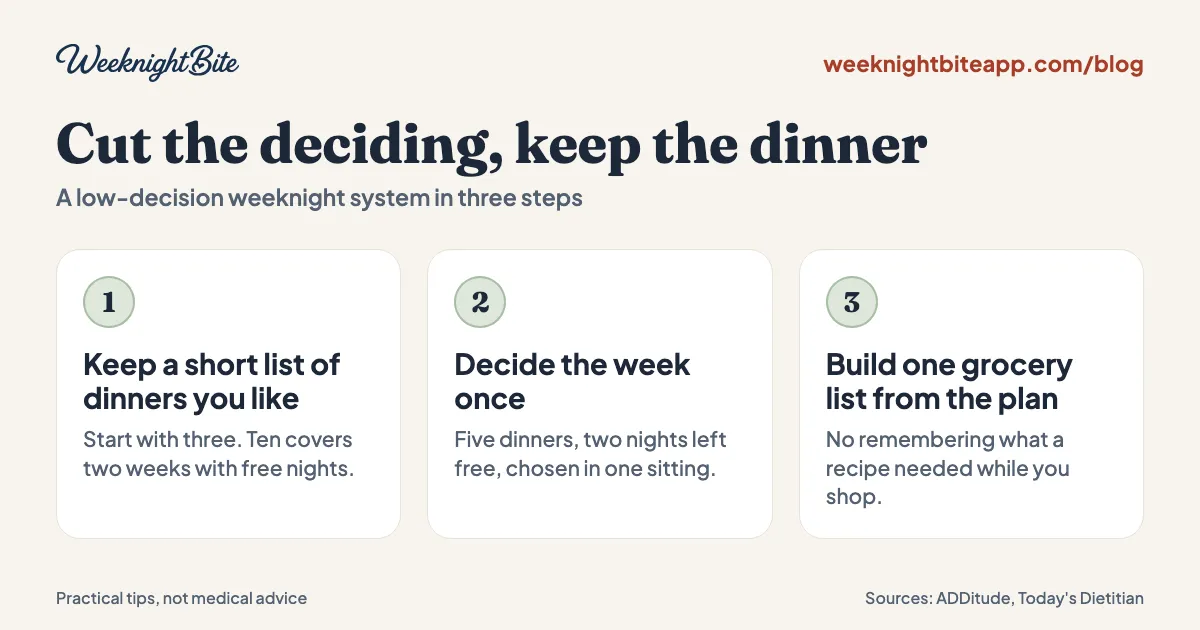
ADHD meal planning works best when it removes decisions instead of adding rules. Keep a short list of dinners you already like, decide the week once, build one grocery list from that plan, and favor meals with few steps and few dishes. Start with three dinners, not a perfect week. This is not medical advice.
For a lot of people with ADHD, the hard part of dinner is not the cooking. It is everything that has to happen before the stove is on: deciding what to make, checking what you have, remembering to buy the rest, and starting at all while you are already tired and hungry. Every one of those is a small decision, and small decisions add up fast at 5 PM.
We are not clinicians, and nothing here is medical or nutrition advice. What follows is a practical system built from two sources written by clinicians, plus what an app can and cannot do about the deciding.
Why is deciding what to cook so hard with ADHD?
Because dinner is a chain of executive-function tasks, not one task. In ADDitude’s meal planning guide, updated by Dr. Patricia Quinn in July 2025, dinner planning is described as decision-making, planning, prioritizing and getting through a visually overwhelming supermarket, all before anything is cooked.
A January 2026 article in Today’s Dietitian by Nicole DeRosa, MS, RDN, LDN, adds a few more pieces: time blindness, trouble getting started, and decision fatigue when time or options are limited. Her point is that conventional meal planning quietly assumes steady energy and reliable executive function, and plenty of people do not work that way.
We see the same thing in how people describe it. In the threads where Mealime users are looking for a replacement, some say plainly that deciding what to eat is the hardest part of the whole job. If that is you, a plan that has more rules is the wrong fix. You want fewer decisions.
What does a low-decision dinner system look like?
It has six parts, and none of them requires a perfect week.
- Shrink the menu. Keep a short list of dinners you would actually eat. ADDitude suggests a top-10 list, which covers two weeks if you leave some nights free, and writing what each meal needs on an index card so you are not rebuilding it from memory.
- Decide once a week, not once a night. Pick the week’s dinners in one sitting. The goal is that at 5 PM the answer to “what’s for dinner” already exists.
- Build the shopping list from the plan, not from memory. One list, made from the meals you chose, means no standing in the aisle trying to remember what a recipe needed. ADDitude’s version turns the index cards into the list itself.
- Pick meals with few steps and few dishes. The fewer things a dinner asks of you, the more likely you start it. This is also why “fastest” is not always the right goal: sometimes fewest dishes is what makes dinner doable.
- Leave slack. Plan five dinners, not seven, and keep a couple of nights free. DeRosa’s version of this is to “meet the minimum” and treat a missed plan as information, not failure.
- Share the load. ADDitude suggests assigning a cook to specific nights. It also suggests splitting shopping into two smaller trips instead of one long one.
| Where dinner usually gets stuck | What removes the decision |
|---|---|
| “What should we eat?” | A short list of dinners you already like, decided once a week |
| “Do we have what we need?” | One grocery list built from the plan |
| “I don’t have the energy to start” | Meals with few steps, and a fewest-dishes option |
| “Someone else has to figure it out” | Assigned cook nights, and a plan your household can see |
| “The plan fell apart” | Free nights built in from the start |
How can a meal planning app take some of this off you?
An app cannot fix executive function, and we do not claim WeeknightBite treats or is designed for ADHD. What an app can do is remove steps from the chain. Here is what WeeknightBite does, as of October 4, 2026.
- A library so you never start from a blank page. The app comes with more than 300 dinners, and most are ready in 30 minutes or less. Every recipe is cooked and tested by a person before it goes in the app.
- Set your diet once. Tell the app your diet and anything you avoid during setup, and it hides library recipes that do not fit.
- Suggested weeks. Instead of building a week from scratch, you can swipe through whole-week plans and use the one you like. Nothing is saved until you confirm it.
- The grocery list builds itself. Save your plan and the list is built from it. The same ingredient across recipes becomes one line, and the list is grouped by aisle. Anyone in your household can open and tick the same list.
- Two ways to cook every recipe. Each recipe has a fastest version and a fewest-dishes version, so you can pick the one your evening can handle. We wrote more about that in our one-pot roundup.
- Calendar-aware busy nights (paid). With the paid Savvy plan you can connect a calendar, see each planned day marked Calm, Moderate or Packed, and get faster dinner options for a packed night.
What it aims to do is shorten the path from “I have no idea” to “here is the plan and the list.” If you are comparing tools, our comparison of Mealime alternatives looks at twelve apps side by side.
What if I skip the plan anyway?
Then nothing has gone wrong. A plan you skip on Wednesday is not a failed week. Keep two or three dinners you can make without a recipe or a shopping trip, and treat the plan as something you return to, not something you have to keep unbroken.
That is the same idea as DeRosa’s “meet the minimum”: aim for a floor you can reach on your worst night, and count everything above it as a bonus.
Frequently asked questions
Does meal planning help with ADHD?
The clinician-written sources above describe planning ahead as a way to avoid many of the daily decisions that make dinner hard. What works varies from person to person, so if you want advice for your own situation, talk to your doctor or a registered dietitian.
How many dinners should I plan for the week?
Five is a good starting point, with two nights left free. ADDitude’s approach is a top-10 list that covers two weeks with free nights, and it is fine to start with three dinners and build from there.
Is WeeknightBite designed for people with ADHD?
No. It is a meal planning app for busy families, and we do not claim it treats or manages ADHD. Fewer decisions at dinner is a goal for a lot of people, and that overlaps with what the sources above describe.
Is WeeknightBite available yet?
Yes. WeeknightBite is free to download on iPhone, iPad and Android; the button at the end of this post takes you to the App Store or Google Play. Coming from Mealime? Paste your recipe links on our Mealime page, and they will be waiting in your account.